Please repost or tweet!
Call for participation: women art enthuasiasts in the Arab Gulf
I am starting research on the phenomenon of women-only viewings at art fairs and museums in the Arab Gulf. If you attend or enjoy art events in the Gulf, I'd like to speak with you. We can communicate via email in Arabic or English, or via Skype or G-Chat in English - unfortunately I am not funded to travel to the Gulf to meet in person. I am happy to protect your privacy in any way you wish.
Below are the kinds of questions I'd like to get a variety of answers to:
What do you think about women-only viewings?
Are they helpful? Does it encourage or discourage you from attending exhibitions? Would you attend if women-only viewings were not scheduled? Do you attend the exhibitions during non-restricted hours?
How do you respond to the idea that women-only events are a “regional custom”? What is your interpretation of this phenomenon? Why do you think it is happening, what do you think is the cause?
I don't have an argument I want to make from your feedback or an agenda, but am generally interested in understanding how different people respond to this occurrence. Please find me at eaharrington at gmail or beth_slnanthro on Twitter; you're also welcome to leave a comment on this blog with a way to get in touch with you.
Abstract:
Viewings for Women Only: The Creation of Homosocial Space through Art Exhibitions in the Arab Gulf
When the new Guggenheim in Abu Dhabi held an initial exhibition of Picasso in 2008, organizers elected to schedule regular viewings restricted to women. The press statement noted that this is a "regional custom to allow women to socialize - and that its inclusion in the retrospective's schedule was meant as a peace offering to the community."
My paper explores the creation of homosocial spaces and their intersection with art, museums, and global politics. I examine the ways in which certain works of art are perceived to be problematic or sexual when viewed in mixed gender settings, and what this solution says about constructions and elicitations of desire. Same-sex settings are seen as neutralizing potentially inflammatory works - does this mean that works are perceived as dangerous not for their inherent content but in their moment and space of their witnessing? Thus, I explore the varying and shifting legibilities of works when they are framed and viewed in different spaces and constructs.
I argue this event demonstrates an attempt by the exhibition organizers, who have links to the Emirati government, to embed museum-going and art viewing behaviors within what Bourdieu would consider the habitus, customs perceived to be established and comfortable for local women. Interviews with Gulf female art visitors and examining other women-only activities for socializing helps to more fully contextualize this practice. This research explores this instance of female homosocial space in relation to similar phenomena in other communities, such as the Aboriginal Australian community, that restrict and divide viewings of art works by gender, drawing on the work of Fred Myers; it also explores the ways that art has previously created homosocial spaces and opened the topic of same-sex desire in Qajar art.
Wednesday, September 28, 2011

Wednesday, August 17, 2011
Curator of Exhibits job @ Ah-Tah-Thi-Ki Museum
Opening: Curator of Exhibits
The Ah-Tah-Thi-Ki Museum has an immediate opening for an experienced Curator of Exhibits. He/She will manage the museum’s Exhibits Division and oversee a staff of two people—an Exhibits Manager and an Exhibits Coordinator. General responsibilities include overseeing the planning, building and installing of exhibits relevant to the museum’s mission of interpreting and disseminating information on the Seminoles. Acting as a division head within the programming area, and reporting to the Programs Officer, he/she will be a vital and integral player on the museum staff. The Curator of Exhibits should be a team player and demonstrate a willingness to advocate for exhibition excellence, promoting esprit de corps, and promoting the museum’s unique mission.
Posted: August 4, 2011
Job Type: Full-Time
Job Duration: Indefinite
Min Education: Master's Degree
Min Experience: 5-7 Years
Required Travel: 10-25%
Job ID: 8432172
Position Title: Curator of Exhibits
Company Name: Ah-Tah-Thi-Ki Museum
Job Function: Exhibitions
Entry Level: No
Location(s): Clewiston, Big Cypress Reservation, 33440, United States
More here.
Opportunities!
CFP: Great Exhibitions in the Margins, 1851-1938
Great Exhibitions in the Margins, 1851 - 1938 University of Wolverhampton,
26-27 April 2012 Research has for a long time focused on world fairs, great exhibitions or
expositions universelles in the capitals of Europe and in the large cities
of the USA. Their crucial role in communicating ideas about the identities
of the exhibiting nations (and their relation to other cultures) and in
showcasing contemporary art and design has been examined in detail.
However, in the heyday of these spectacular events - in the second half of
the nineteenth and the first half of the twentieth century - smaller
cities and regional centres, such as Liege, Poznan, Edinburgh or
Wolverhampton, staged their own 'great exhibitions' modelled on those held
in the national (or imperial) centres. Their goals, although executed on a
more modest scale, were often the same and involved the promotion and sale
of goods but also communication of ideas, ideologies and identities. These
smaller shows usually had large ambitions and tried to engage not only the
local population but also national and international audiences and
exhibitors.
This symposium turns attention to the exhibitions of arts and industries
in the regions outside the capitals and to the assumptions that lay behind
them. Its main focus will be placed on their ambitions, originality,
relationship to the ��greater�� exhibitions and, in particular,
their engagement with visual culture. The questions explored may include:
- what ambitions motivated the idea of staging an exhibition in the
particular location and what were its objectives
- what was the long-term impact of the show on the region, nationally
and internationally
- how were the arts displayed at the exhibition and what role they
played
- what specific influence did exhibitions like the Great Exhibition or
Expositions Universelles in Paris have on the exhibitions in the margins?
The symposium encourages an inter-disciplinary approach to the topic and
papers are therefore welcome from scholars in a wide range of disciplines,
including the history of art and design, history, politics, anthropology,
ethnography, cultural studies etc. A network of researchers interested in
the subject of exhibition cultures will be created through the symposium
as further academic activities on the theme are planned (a publication and
a research network). News about the symposium and the research network
will be posted at http://greatexhibitions.blogspot.com.
Please send your paper proposals of up to 250 words to Dr. Marta Filipova
at Marta.Filipova@wlv.ac.uk by 1 November 2011.
-----------------------------------------------------------
Monday, August 15, 2011
LAST CALL FOR NOMINATIONS
Ames Prize for Innovative Museum Anthropology
The Michael M. Ames Prize for Innovative Museum Anthropology is awarded annually to individuals for innovative work in museum anthropology, which is understood to entail outstanding single or multi-authored books, published catalogues, temporary and permanent exhibits, repatriation projects, collaborations with descendant communities, educational or outreach projects, multimedia works, and other endeavors. Individuals can be nominated by any member of CMA. A letter of nomination and any supporting material should accompany a copy of the evidence of the work under consideration. The CMA President will appoint a prize committee of three people at the CMA Board of Directors meeting held at the AAA Annual Meeting. The prize committee will review the works and the prize-winners will be notified in advance of the annual AAA meetings so that they can consider attending. The prize winner will be announced at the AAA Annual Meeting and presented with a certificate of the award.
Nomination:
• Deadline: SEPTEMBER 1, 2011
• The nominator must be a current CMA member in good standing
• Self-nominations are allowed
• Hard copies or electronic copies of nomination packets and materials must be sent by the nominator to each of the three prize committee members
• Nomination packets should include a cover letter and the work under consideration (or evidence of it), as well as any supporting materials, such as letters of support, media coverage, DVDs, etc.
• Nomination packets will not be returned
Evaluation Criteria:
• Creativity: Is the project a unique and creative exploration of museum anthropology’s central themes, tensions, and histories?
• Timeliness: Does the project say something important about museum anthropology’s current predicaments and unknown future?
• Depth: In what ways does the project penetrate into the complexity of material culture and the study of it through novel methods and theories?
• Impact: Does the project have the potential to make broad and lasting impacts in museum anthropology?
Process and Rules:
• A three-person prize committee of CMA members, headed by a committee chair, will be constituted by the current CMA President at the annual AAA Board of Directors meeting each year
• The committee will be formally announced by January 15 annually, with the addresses of each committee member publicized
• All nomination materials must be received by September 1, although incomplete nominations may still be considered based on the materials provided
• If no qualified nominations are made, the prize committee may elect to refrain from presenting the award for that year
Instructions:
For the 2011 competition, send one copy of the nomination packet to each committee member:
Jennifer Kramer
Curator of the Pacific Northwest
Assistant Professor of Anthropology
UBC Museum of Anthropology
6393 NW Marine Dr.
Vancouver, BC V6T 1Z2
Canada
Email: Jennifer.kramer@ubc.ca
Chip Colwell-Chanthaphonh
Department of Anthropology
Denver Museum of Nature & Science
2001 Colorado Boulevard
Denver, CO 80205
USA
Email: Chip.C-C@dmns.org
Kathleen Adams
Professor of Anthropology
Department of Anthropology
402 Coffey Hall
Loyola University Chicago
1032 W. Sheridan Road,
Chicago, IL 60660
USA
Email: kadams@luc.edu
Any questions should be directed to the prize committee chair at jennifer.kramer@ubc.ca.
------------------------------------------------------------------
NYC-based photographers who are interested in volunteering to shoot for Open House NY should contact me! October 15-16.
Monday, June 27, 2011
OPEN CALL/CFP: FOLK ARTS AND SOCIAL CHANGE RESIDENCIES
reposted from the Philadelphia Folklore Project -
OPEN CALL: FOLK ARTS AND SOCIAL CHANGE RESIDENCIES
Show and share your work in our gallery
The Philadelphia Folklore Project announces new exhibition opportunities for people working in local communities and addressing social change. (For a pdf of this page, click here.)
If you are directly creating folk and traditional arts or doing documentary work about local grassroots community experiences and expressions, we invite you to apply. Propose a project that can have meaningful impact, both for you and more widely. Residencies offer stipends of $1,000 - $3,000 as well as an exhibition in our gallery between September 2011 and August 2012.
Who: We invite proposals from Philadelphia-area residents who work in community artistic traditions/folk arts or who conduct grassroots or ethnographic documentation. By folk arts, we mean community-based arts: traditions rooted in shared and evolving heritage or experiences. We see folk arts as collective traditions: arts that represent more than an individual vision.
What: Projects that can be done for $3,000 or less, and installed over 1-3 months at PFP are possible. In addition to the stipend and space*, we provide a public opening reception, publicity and interpretive materials, and technical assistance as needed. PFP staff will support exhibition planning and production, develop publicity and interpretive materials, and support community outreach and public programs. Artists chosen for residencies are asked to present at least one public event sharing or talking about their cultural or documentary work and the issues it addresses, and to participate in several meetings with PFP staff and other residents. We expect to support up to 5 different projects.
When: Application deadline, July 1, 2011. Residency projects will be on display for 1-3 months between September 2011 and August 2012. (Exhibition durations will vary depending on proposed projects).
Where: Exhibitions will be installed at PFP, 735 S. 50th Street, Philadelphia, PA 19143
Why this program? People working in folk and traditional arts create meaningful alternatives for their communities, but lack many kinds of resources to sustain their practice. We value folk arts: the spaces they claim, the relationships they embody, and the possibilities they offer. We invite you to bring your arts and concerns into our gallery, and to consider how our space and support can help you take next steps in work that matters.
Read more about the CFP here.
Sunday, June 26, 2011
NYC History: Greenwood Cemetery

Well, now that Hatred is buried, we can move forward as a planet, right?
Recently I visited Greenwood Cemetery for the first time, which is mildly embarrassing given that I've lived 20 blocks away from this historic landmark for 2 years now. Perhaps I felt that cemeteries are morbid (or a site of abjectourism, perhaps?), but I'm glad I got over my hangup!
Greenwood Cemetery was founded in 1838, and spans 478 acres of hilly, once-rural Brooklyn. Famous folks are buried here, from Bill the Butcher (see: Gangs of New York), Louis Comfort Tiffany, Jean-Michel Basquiat, Boss Tweed, Leonard Bernstein, and Susan Smith McKinney-Stewards, New York's first black woman doctor.


Greenwood is absolutely beautiful, and relaxing.


And the lovely Greenwood Chapel:


I highly recommend taking a walk through Greenwood during the summer. It's a calming throwback to Old New York, and one of the few places in America with substantive and lengthy history.

Wednesday, June 15, 2011
Displaying the (Australian) Nation: Looking at Representation at the National Gallery of Victoria, Melbourne, Australia
Recently I had the good fortune to be in Melbourne, Australia, and I visited the National Gallery of Victoria (NGV). The NGV is vaguely akin to the Smithsonian, and so there are several branches, including the Ian Potter Center that includes some very interesting work.

The entryway to the main NGV Galleries (free, by the way) is beautiful, covered in a falling water installation.

In these galleries, a few works in particular caught my attention.
Marjetica Potrc is an artist and architect from Ljubljana. Her work Urban, 2001, is a series of photographs of urban spaces and buildings.

Potrc complicates easy narratives around these images of urban life, both cluttered (slums) and glamorous or sleek (skyscrapers) by layering text around and through them that tells fragments of stories. Information panels tell the viewer, "Each depictions of the city considers community, a sense of place and belonging, and conversely, detachment and alienation." I found Potrc's work thought-provoking, and an interesting juxtaposition of her artistic and architectural talents.

I also enjoyed
Yayoi Kusama's installation of Tender are the stairs to Heaven (2004). Something about the ladder streaming upwards and the slowly melting colors was tremendously relaxing and meditative.
Nearby, another branch of the NGV, is the Ian Potter Centre.

This branch contains the Qantas-funded Aboriginal Art Galleries, which include both traditional/historical works as well as contemporary art.

The galleries are spacious and airy, and look like this:


Traditional decorative weaving is also included.

Wall text from artists remind visitors that painting is a political and agentive act, and that the history of Aboriginal painting in Australia has been laden with difficulty, tension and struggle. As scholar Fred Myers relates, Aboriginal artists were often taken advantage of by gallerists and dealers as their work came to represent the Australian nation, a nation which did not necessarily acknowledge rights to these same peoples.

Some of the text panels read like the works on display are purely artistic, with no additional or interpretive information presented, whereas others include part of the artist's story, which helps the works to be seen as cultural artifacts (rather than as purely art works). It is also critical to clarify that providing descriptions that help the viewer decipher these works can be read in two ways: first, that as Bourdieu tells us, all art is read and understood by decoding certain symbols and its legibility, that is, that its meaning is encoded and understood by those who know the key and find it legible and so providing this type of key and description helps build this lexicon in the viewers, which they can then carry to interpret other works; alternatively, providing such a key can come across as condescending or as acknowledging these works' location outside the historic Western art canon.

I was really taken by Johnny Warangkula Tjupurrala's A bushtucker's story, below.

And a closeup:

I just thought this painting was stunning in its complexity, delicate colors, and careful details. It reminded me of Monet's gardens at Giverny, if seen through a Seurrat-ian eye.
Other paintings were depicted very clearly as cultural artifacts that allowed the visitor a view into Aboriginal culture and beliefs around certain social practices or understandings, as this painting, Mimih spirit and human reproduction.

Another work I found compelling was Ruby Tjangawa Williamson's Puli murpu (Mountain range). Wall text assists the viewer in deciphering the image.


In the contemporary art section, I was completely mesmerized by Samantha Hobson's Bust 'im up, 2000, seen below in details. I have also included the wall panel, so readers can see that Hobson's geographic and tribal affiliation. The galleries are clearly attempting to promote seeing these artists as individuals, with distinct cultural, geographic, and social backgrounds.


And finally, Mirdidingkingathi Jurwunda Sally Gabori's 2008 work, Ninjiki, is absolutely incredible. If I could cover a wall with this painting, and another with Lee Krasner's Gaea, 1966...

Overall, the NGV is making strides to promote varied and nuanced interpretations of works by Aboriginal artists, which is positive and should be encouraged and valued (not all museums are so nuanced in their thinking and representation of native peoples). However, when I went to the gift shop to look for postcards of the works I had fallen in love with (those above!), I was saddened to find that the only postcards available were from the "main" galleries, and there were no postcards of works in the Aboriginal galleries for sale. Thus it seems that wall panels and display aside, the NGV and its gift shop are still rooted in a normative and normalizing view of what constitutes "art."

The entryway to the main NGV Galleries (free, by the way) is beautiful, covered in a falling water installation.

In these galleries, a few works in particular caught my attention.
Marjetica Potrc is an artist and architect from Ljubljana. Her work Urban, 2001, is a series of photographs of urban spaces and buildings.

Potrc complicates easy narratives around these images of urban life, both cluttered (slums) and glamorous or sleek (skyscrapers) by layering text around and through them that tells fragments of stories. Information panels tell the viewer, "Each depictions of the city considers community, a sense of place and belonging, and conversely, detachment and alienation." I found Potrc's work thought-provoking, and an interesting juxtaposition of her artistic and architectural talents.

I also enjoyed
Yayoi Kusama's installation of Tender are the stairs to Heaven (2004). Something about the ladder streaming upwards and the slowly melting colors was tremendously relaxing and meditative.
Nearby, another branch of the NGV, is the Ian Potter Centre.

This branch contains the Qantas-funded Aboriginal Art Galleries, which include both traditional/historical works as well as contemporary art.
The galleries are spacious and airy, and look like this:

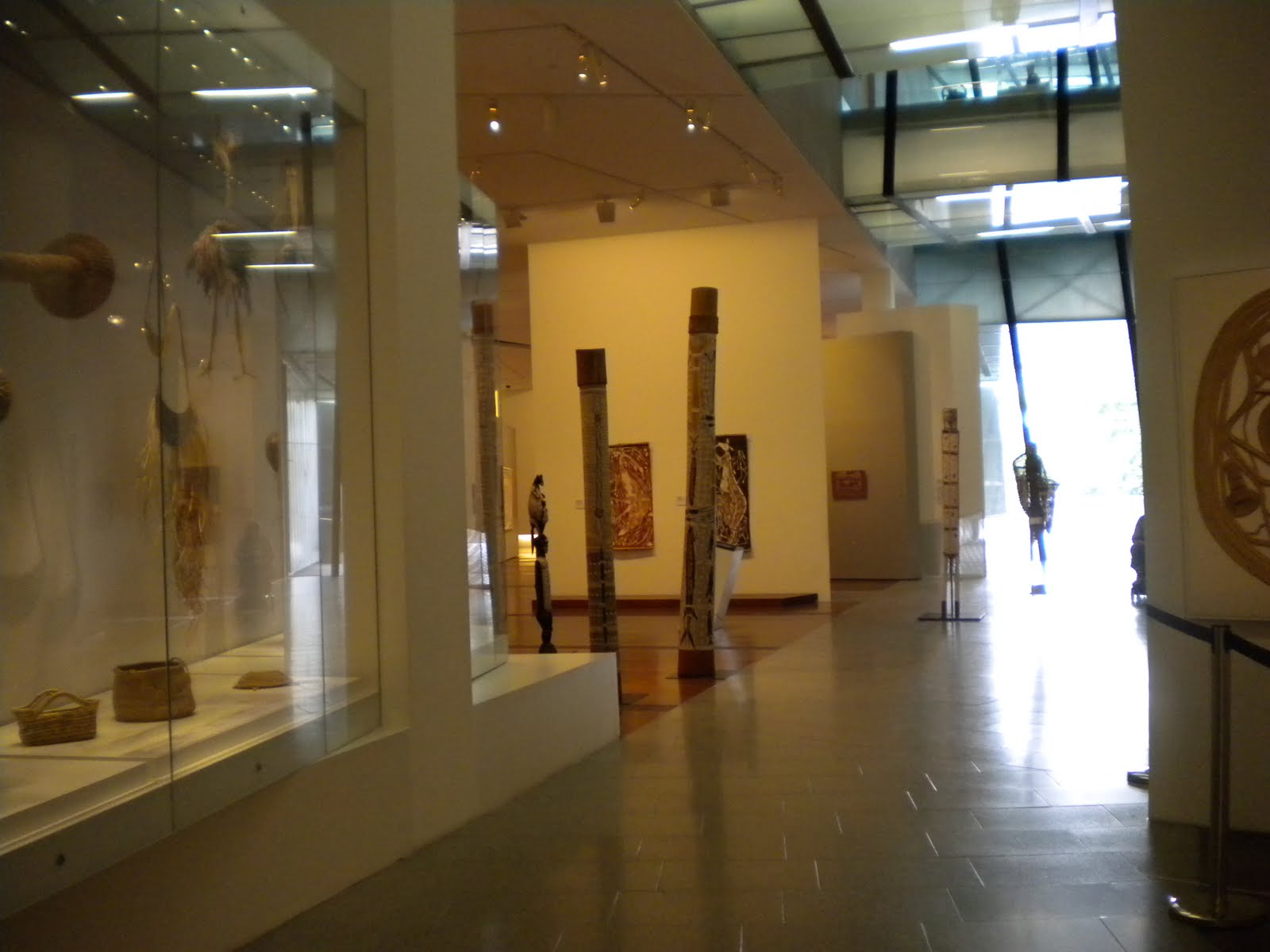
Traditional decorative weaving is also included.

Wall text from artists remind visitors that painting is a political and agentive act, and that the history of Aboriginal painting in Australia has been laden with difficulty, tension and struggle. As scholar Fred Myers relates, Aboriginal artists were often taken advantage of by gallerists and dealers as their work came to represent the Australian nation, a nation which did not necessarily acknowledge rights to these same peoples.

Some of the text panels read like the works on display are purely artistic, with no additional or interpretive information presented, whereas others include part of the artist's story, which helps the works to be seen as cultural artifacts (rather than as purely art works). It is also critical to clarify that providing descriptions that help the viewer decipher these works can be read in two ways: first, that as Bourdieu tells us, all art is read and understood by decoding certain symbols and its legibility, that is, that its meaning is encoded and understood by those who know the key and find it legible and so providing this type of key and description helps build this lexicon in the viewers, which they can then carry to interpret other works; alternatively, providing such a key can come across as condescending or as acknowledging these works' location outside the historic Western art canon.

I was really taken by Johnny Warangkula Tjupurrala's A bushtucker's story, below.

And a closeup:

I just thought this painting was stunning in its complexity, delicate colors, and careful details. It reminded me of Monet's gardens at Giverny, if seen through a Seurrat-ian eye.
Other paintings were depicted very clearly as cultural artifacts that allowed the visitor a view into Aboriginal culture and beliefs around certain social practices or understandings, as this painting, Mimih spirit and human reproduction.

Another work I found compelling was Ruby Tjangawa Williamson's Puli murpu (Mountain range). Wall text assists the viewer in deciphering the image.


In the contemporary art section, I was completely mesmerized by Samantha Hobson's Bust 'im up, 2000, seen below in details. I have also included the wall panel, so readers can see that Hobson's geographic and tribal affiliation. The galleries are clearly attempting to promote seeing these artists as individuals, with distinct cultural, geographic, and social backgrounds.


And finally, Mirdidingkingathi Jurwunda Sally Gabori's 2008 work, Ninjiki, is absolutely incredible. If I could cover a wall with this painting, and another with Lee Krasner's Gaea, 1966...

Overall, the NGV is making strides to promote varied and nuanced interpretations of works by Aboriginal artists, which is positive and should be encouraged and valued (not all museums are so nuanced in their thinking and representation of native peoples). However, when I went to the gift shop to look for postcards of the works I had fallen in love with (those above!), I was saddened to find that the only postcards available were from the "main" galleries, and there were no postcards of works in the Aboriginal galleries for sale. Thus it seems that wall panels and display aside, the NGV and its gift shop are still rooted in a normative and normalizing view of what constitutes "art."
Friday, June 10, 2011
Stuart Hall on Hegemony
"Hegemony...is never completed. It is always trying to enclose more differences within itself. Not within itself. It doesn't want the differences to look exactly like it. But it wants the projects of its individual and smaller identities to be only possible if the larger one becomes possible. That is how Thatcherism locates smaller identities within itself. You want to have the traditional family? You cannot do it for yourself because it depends on larger political and economic things. If you want to do that, you must come inside my larger project. You must identify yourself with the larger things inside my project. That is how you become part of history. You become a little cog in the larger part of history.
Now that is a different game from saying, "I want everybody to be exactly a replica of me." It is a more complicated game. But there is a moment when it always declares itself to be universal and closed, and that is the moment of naturalization. That's the moment when it wants its boundaries to be coterminous with the truth, with the reality of history. And that is always the moment which, I think, escapes it. That's my hope. Something had better be escaping it."
from "Old and New Identities, Old and New Ethniticies"
Subscribe to:
Posts (Atom)